
Guthrie County Bench Warrants Explained
People say "bench warrant" when a court orders an arrest because someone failed to show up or follow through on an obligation. That shorthand rarely appears in the Iowa records themselves. A Guthrie County docket is more likely to read "arrest warrant for failure to appear," "warrant issued," or wording tied to the specific order, and the exact entry is what matters. The triggers vary. A missed initial appearance, traffic setting, pretrial hearing, status hearing, or sentencing can all prompt a Guthrie County bench warrant. So can breaking release terms, ignoring another court order, or failing to appear over unpaid court debt. Even so, an unpaid sum alone does not create a warrant automatically.
Guthrie District Court Bench Warrants
There is no separate county criminal court here. Guthrie County sits inside Iowa's unified District Court, where district judges, district associate judges, and magistrates all work. The Guthrie County Clerk of Court holds the filed case records and the public docket entries. Magistrates handle many simple misdemeanors, traffic and ordinance violations, preliminary hearings, search-warrant proceedings, county and municipal infractions, and other assigned matters. They can issue warrants, order arrests, and take bail. District and district associate judges take the more serious criminal cases and sentencing matters. Whatever the division, take the warrant question to the part of the court that issued it.
How Guthrie County Bench Warrants Are Issued
Every Guthrie County bench warrant traces back to a required court date or act. Miss it, and the judge or magistrate reviews the case and may direct an arrest. For citations, Iowa Code section 805.5 says a willful failure to make the required appearance causes the court to issue an arrest warrant for failure to appear. Iowa Rule of Criminal Procedure 2.36 Form 7 lays out a sentencing path instead. That blank form identifies the state and county, criminal case number, conviction date, offense and statute, the command to peace officers, the direction to bring the person before the court, the date, and the judge or clerk signature. It is only a schema, not a live Guthrie County bench warrant. The flow itself is simple. Required appearance, missed obligation, judicial review, warrant order, service or recall, and the case resumes.
Read Guthrie County Warrant FTA Events
The free Iowa Courts Online docket is the place to start. Search by case ID, citation number, or accurate name details, then select Guthrie County. Read events in order, watching for failure to appear, warrant issued, bond, return, recall, quash, payment, and new hearing entries. A name match alone proves nothing about identity.
- FTA
- Failure to appear at a required court proceeding.
- Bench warrant
- Common term for court-directed arrest after nonappearance or noncompliance.
- Recall
- The issuing court withdraws its warrant.
- Quash
- A judge ends the warrant by court order.
- Return
- An officer or court filing records execution or service.
A newer entry can undo an older warrant event in Guthrie County. Confirm with the clerk and sheriff.
Bench Warrants and Arrest Warrants Compared
Both orders command peace officers to arrest. They just begin at different stages. Knowing the difference helps you ask the right Guthrie County office about the case.
| Feature | Bench or FTA warrant | Probable-cause arrest warrant |
|---|---|---|
| Typical trigger | Missed court act or noncompliance | Complaint and probable-cause finding |
| Case stage | Usually an existing court matter | May begin or advance prosecution |
| Iowa wording | Bench warrant or arrest warrant for FTA | Arrest warrant on complaint, indictment, or information |
| Public access | A docket event may later appear | Supporting material may stay confidential before service |
| Resolution | Issuing judge controls recall, quash, setting, or compliance | Arrest, appearance, bond, and court orders govern |
Everyday speech blurs the terms. Use the exact docket language with the Guthrie clerk or counsel.
Iowa Uses FTA, Not Capias
Iowa records for Guthrie County say "arrest warrant," "failure to appear," and "bench warrant." You will not find the Texas phrase "capias pro fine" used here for fine collection. Calling every court warrant a capias would just muddy the actual Iowa record. A failure-to-appear warrant means the court ordered an arrest after a required appearance was missed in that context. It is not a search warrant, which authorizes a search based on probable cause. It also differs from a municipal-infraction citation. That paper is civil city-code enforcement, and it is not automatically an arrest warrant in Guthrie County.
Use the record’s words: Ask whether the docket shows an FTA warrant, sentencing warrant, return, recall, or quash.
Guthrie FTA Statute Record
The official Iowa Code chapter 805 interface is the source for the failure-to-appear rule.
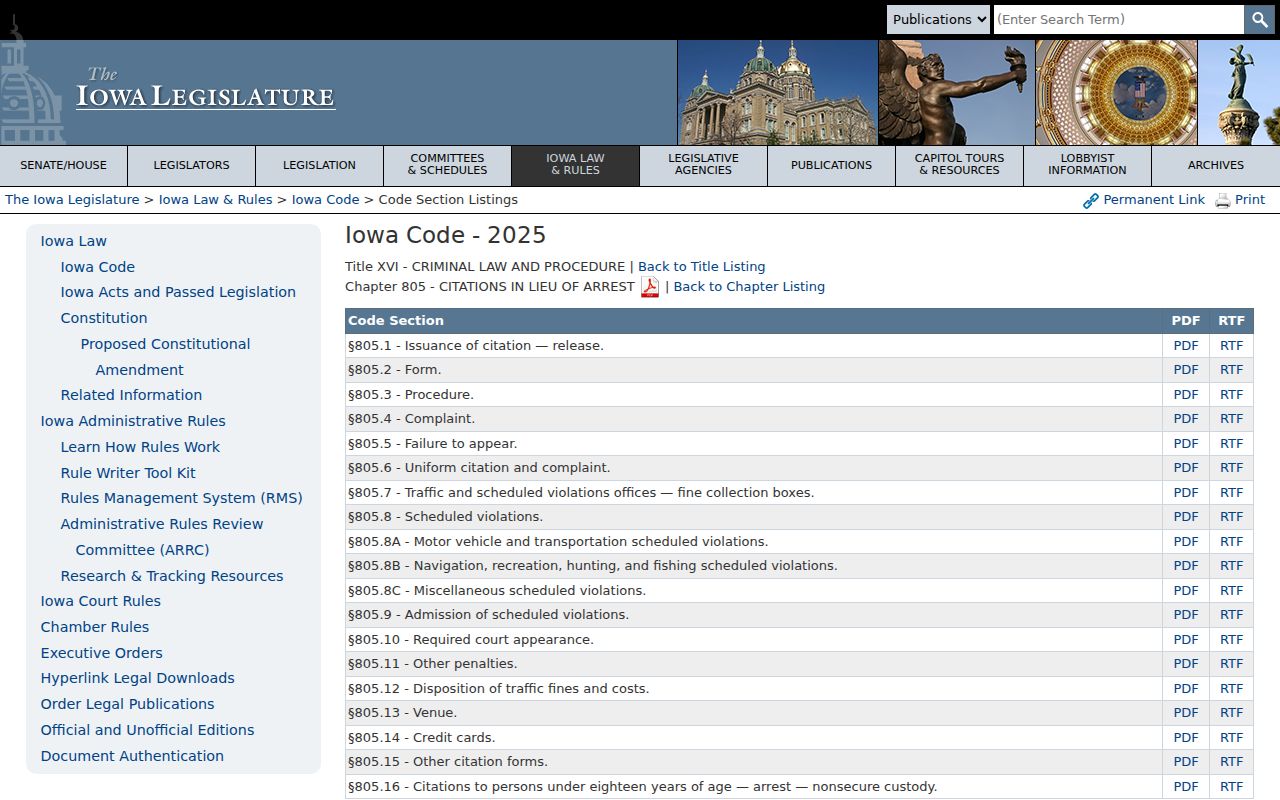
The state text uses arrest-warrant language for willful failure to appear. "Bench warrant" is a handy public description in Guthrie County, not a guaranteed database class.
Resolving a Guthrie County Bench Warrant
Start by finding the source. Write down the case ID, citation number, missed date, and newest docket language, then call the Guthrie County Clerk of Court at 641-747-3415. Ask whether the record shows a warrant, bond, recall or quash order, payment, or a new hearing, and whether a filing is required. Next, contact the Guthrie County Sheriff/Jail at 641-747-2214 for enforcement confirmation and current surrender instructions. The county publishes no walk-in window, after-hours method, identification list, or bond-window hours. Do not guess.
- Find and save the exact court case identifier.
- Confirm the filed entry with the clerk.
- Consult an Iowa attorney about arrest risk and options.
- Follow the issuing court’s order for appearance, filing, payment, bond, or surrender.
- Keep written proof and verify that both court and agency records update.
Caution: Payment or a new date does not recall a Guthrie County bench warrant unless the issuing court takes that action.
After Missing Guthrie County Court
Missed a date in Guthrie County court? Move fast, but move carefully. Check the docket first, and talk to a lawyer before walking into any office if an arrest seems possible. Counsel can reach the issuing court directly and ask which fix fits the case: a motion to recall or quash, a new setting, authorized compliance, bond, or an arranged surrender.
The missed matter may involve a traffic citation or court debt. The Judicial Branch allows approved payment routes in eligible cases. Payment-plan requests can be made in writing or in person at the county clerk. Confirm first that payment is legally available in your case. Paying may address the debt while the warrant still stands. A willful citation-related failure to appear can be a simple misdemeanor under section 805.5, and other qualifying failures after release can affect security, bond, and criminal consequences. And no, a bench warrant does not simply expire.
Guthrie Clerk, Sheriff, and Counsel
Each office in Guthrie County plays one narrow part. The clerk pulls the filed docket, explains public access, spots case numbers, and routes payment or copy questions. Court staff cannot act as defense counsel. They also cannot promise a law-enforcement record has cleared. The sheriff and jail handle service, custody, local confirmation, and surrender routing. No sheriff can withdraw a judge's warrant. Counsel can weigh arrest risk, speak with the issuing court, and file a proper request, but only a judge or magistrate may order a recall or quash.
| Clerk of Court | 200 N 5th Street, Guthrie Center; 641-747-3415 |
|---|---|
| Sheriff/Jail | 200 N 5th Street, Guthrie Center; 641-747-2214 |
| Issuing judge | Controls court setting, bond, recall, quash, and other orders |
| Attorney | Gives legal advice and communicates or files as authorized |
Finding the Court That Issued the Warrant
Which court issued it depends on the case type. Guthrie County magistrate Timothy J. Farmer handles traffic, simple-misdemeanor, ordinance, preliminary, and municipal-infraction matters within District 5. More serious criminal proceedings, sentencing, and enforcement of court orders go to a district or district associate judge. A city citation can still reach Iowa District Court. Iowa Code section 364.22 sends the original civil municipal-infraction citation to the Clerk of District Court. That paper is not an arrest warrant. Check any missed court duty in the actual docket. Another Iowa county's court, or a federal one, sits outside the Guthrie County clerk's records. Ask which court issued the order before seeking relief. The Guthrie County warrant records overview distinguishes local, state, and federal routes.
Guthrie Bench Warrant Access Limits
Iowa keeps some Guthrie County warrant material out of public view. Iowa Code section 804.29 makes information used to secure an arrest warrant confidential until arrest and return or initial appearance, unless a court orders otherwise. Ongoing investigations, juvenile matters, and other protected records may be withheld or redacted. A public docket later on still does not open every supporting document. Iowa Code chapter 22 governs public records generally. A request goes to the lawful custodian, though. The clerk holds filed court records. The sheriff holds law-enforcement records. Each office applies the laws and court orders that govern its own material. The courthouse public terminal may show documents the online docket does not. After recall, quash, bond, surrender, or a new setting, keep the signed order or receipt. Recheck the docket, and ask the sheriff how its enforcement record will reflect the change. Written proof beats a vanished search result.